



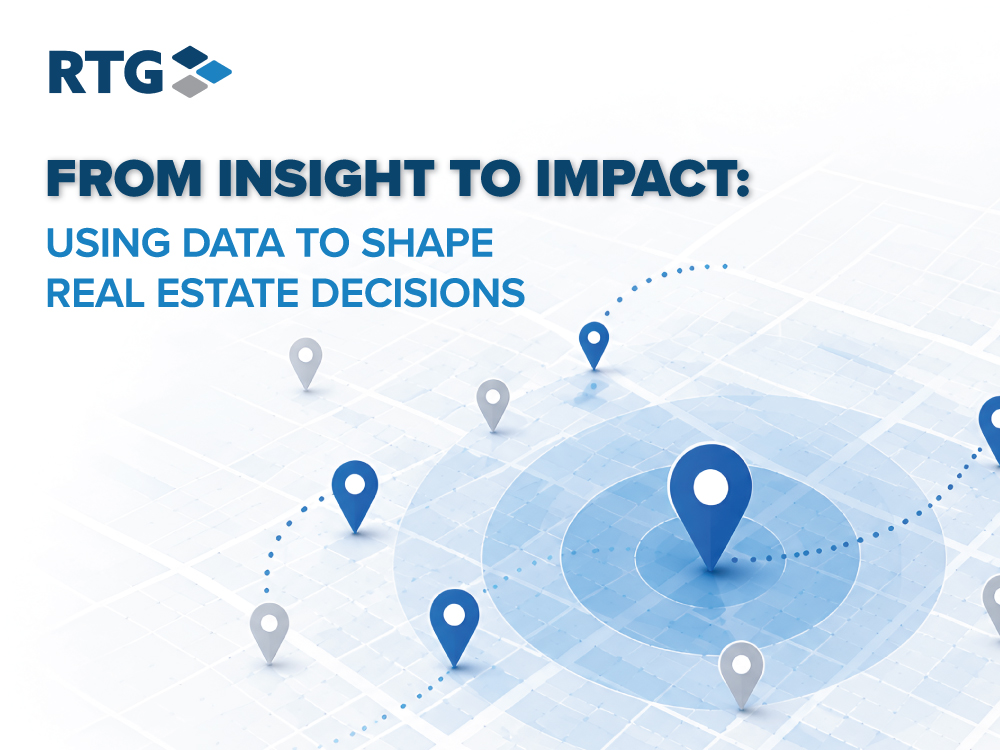
From Insight to Impact: Using Data to Shape Real Estate Decisions

Executive White Paper
Discover how patient analytics, site productivity benchmarking, and market intelligence help healthcare leaders make more confident, defensible real estate decisions.
Turn Existing Healthcare Data Into Actionable Real Estate Insight
Healthcare organizations already possess one of their most valuable strategic assets: their own patient data. The challenge is not collecting information. It is transforming that information into insight that can guide growth, capital deployment, and portfolio performance.
RTG helps health systems move beyond assumptions by combining patient origin analysis, portfolio performance benchmarking, and market intelligence into a strategic framework that aligns real estate with broader organizational goals.
Turning Data Into Strategy
RTG helps health systems transform patient and portfolio data into actionable insight that supports better decision-making. By analyzing where patients live, how they access care, and how each site performs, organizations gain a clearer understanding of where demand exists, where growth opportunities are emerging, and where performance can be improved.
This approach gives healthcare leadership a more complete view of both the market and the existing real estate portfolio.
Patient Origin Analysis
Identify where patients live, how they access care, and where unmet demand or future growth opportunities may be emerging.
Site Productivity Index
Benchmark every location using visit volume, square footage, utilization, and national healthcare real estate performance data.
RTG PinPoint Analytics
Bring patient, portfolio, demographic, referral, and competitor data together in a centralized platform built for executive decision-making.
A Framework for Better Decisions
RTG’s approach combines multiple sources of patient, market, and portfolio data into a single strategic framework. This gives healthcare leadership a consistent and defensible way to evaluate opportunities, prioritize capital, and align real estate decisions with broader financial and operational goals.
Through this framework, organizations can:
Identify High-Impact Locations for Growth
Evaluate patient origin patterns, drive times, population shifts, housing development, and competitive activity to determine where new access points can capture meaningful demand.
Evaluate Performance Across the Portfolio
Compare visit volume, square footage, utilization, and national performance benchmarks to identify sites that should be optimized, expanded, right-sized, repurposed, or exited.
Align Real Estate With Financial and Operational Goals
Prioritize decisions according to organizational strategy, capital capacity, service-line needs, growth objectives, and long-term market positioning.
Key Takeaway
This replaces fragmented analysis and subjective assessments with a consistent, transparent, and defensible decision-making process.
5%
Increase in Market Share
Within 24 Months
Measurable Impact
Growth Without Disrupting Existing Locations
In one engagement, RTG’s analysis identified an underserved submarket within a client’s core service area. A strategically placed outpatient facility increased market share by 5% within 24 months without disrupting existing locations.
Continue the Conversation
See the Strategy Behind Smarter Real Estate Decisions
Discover how healthcare organizations are using patient data, market intelligence, and portfolio analytics to align real estate decisions with long-term strategy.
Common Questions Healthcare Leaders Ask About Data-Driven Real Estate Decisions
Health systems are making increasingly complex real estate decisions in an environment shaped by margin pressure, shifting patient demand, and growing competition. As organizations look to strengthen market position and deploy capital more strategically, executives are asking how patient and portfolio data can improve site selection, reduce financial risk, and support long-term growth.
The following Q&A answers common questions about data-driven real estate strategy, including how patient origin analysis, site productivity benchmarking, and integrated analytics help healthcare leaders make more confident, defensible real estate decisions.
What does “data-driven real estate strategy” actually mean?
It means making real estate decisions based on patient demand, site performance, and market data—not assumptions.
Why are traditional real estate planning methods falling short?
They rely on fragmented data and subjective assessments, limiting visibility into true demand and performance.
How can patient data improve site selection?
Patient data reveals where demand exists and where new locations will generate growth instead of shifting volume.
What is the Site Productivity Index?
It is a framework that measures site performance using visit volume, square footage, and national benchmarks.
How does a data-driven approach reduce financial risk?
It helps avoid overbuilding, reduce underutilized space, and align real estate decisions with financial performance.